Showing posts with label Magazine Covers. Show all posts

Thursday, April 27, 2023

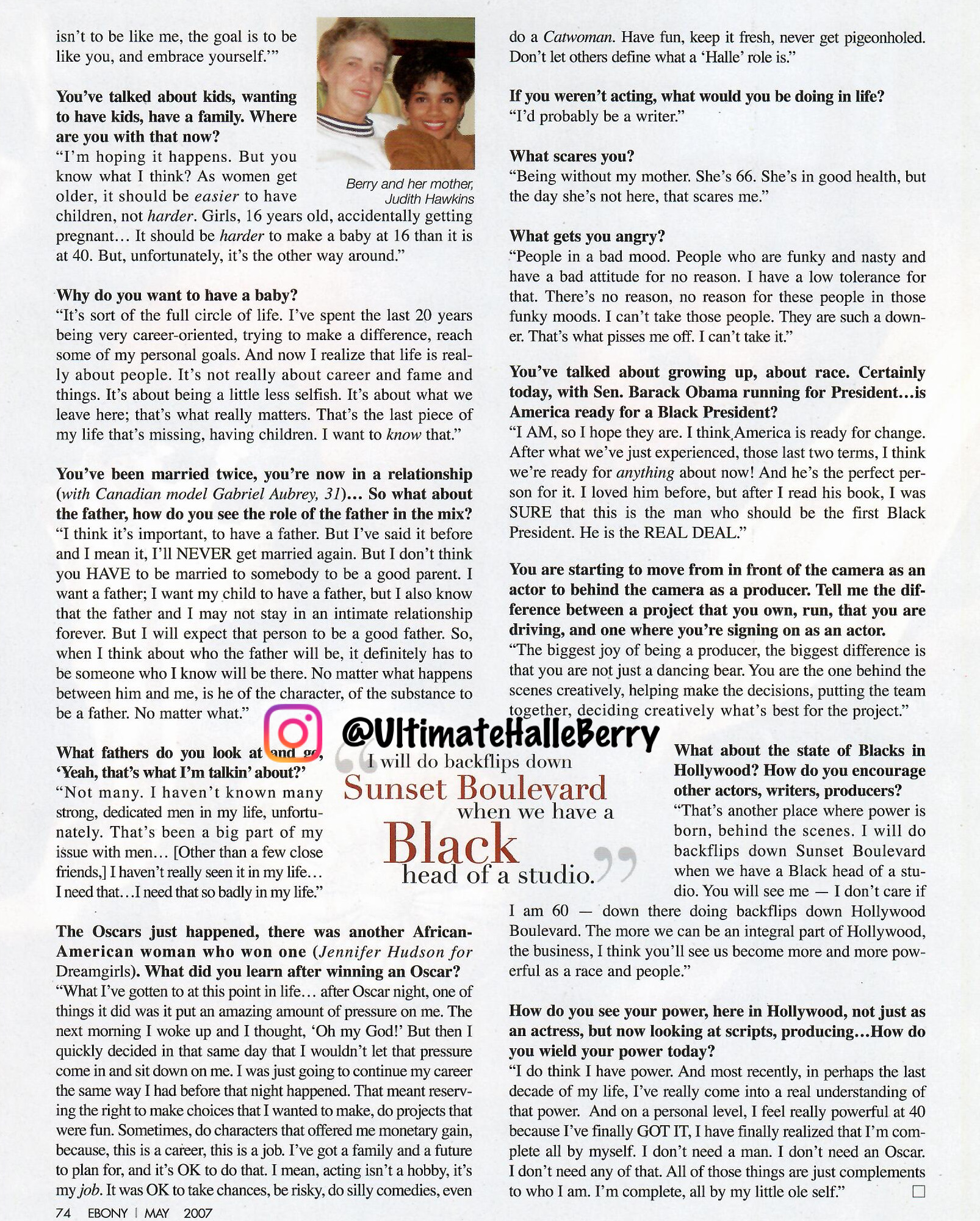
Halle Highlights: Halle Berry Covers May 2007 Issue of 'Ebony'

Halle Highlights, a feature here at Ultimate Halle Berry, continues to showcase some of the standout moments (interviews, awards, magazine covers, etc.) from Academy Award winner Halle Berry's multi-decade career.

Back in May 2007, Berry covered Ebony magazine's Power 150 issue, where she talked about her utilizing her power, her latest projects at the time ('Perfect Stranger', 'Things We Lost in the Fire', etc.) and her desire to have a baby. Read the full article below:

Saturday, January 22, 2022

Halle Berry Pens Touching Tribute To Sidney Poitier

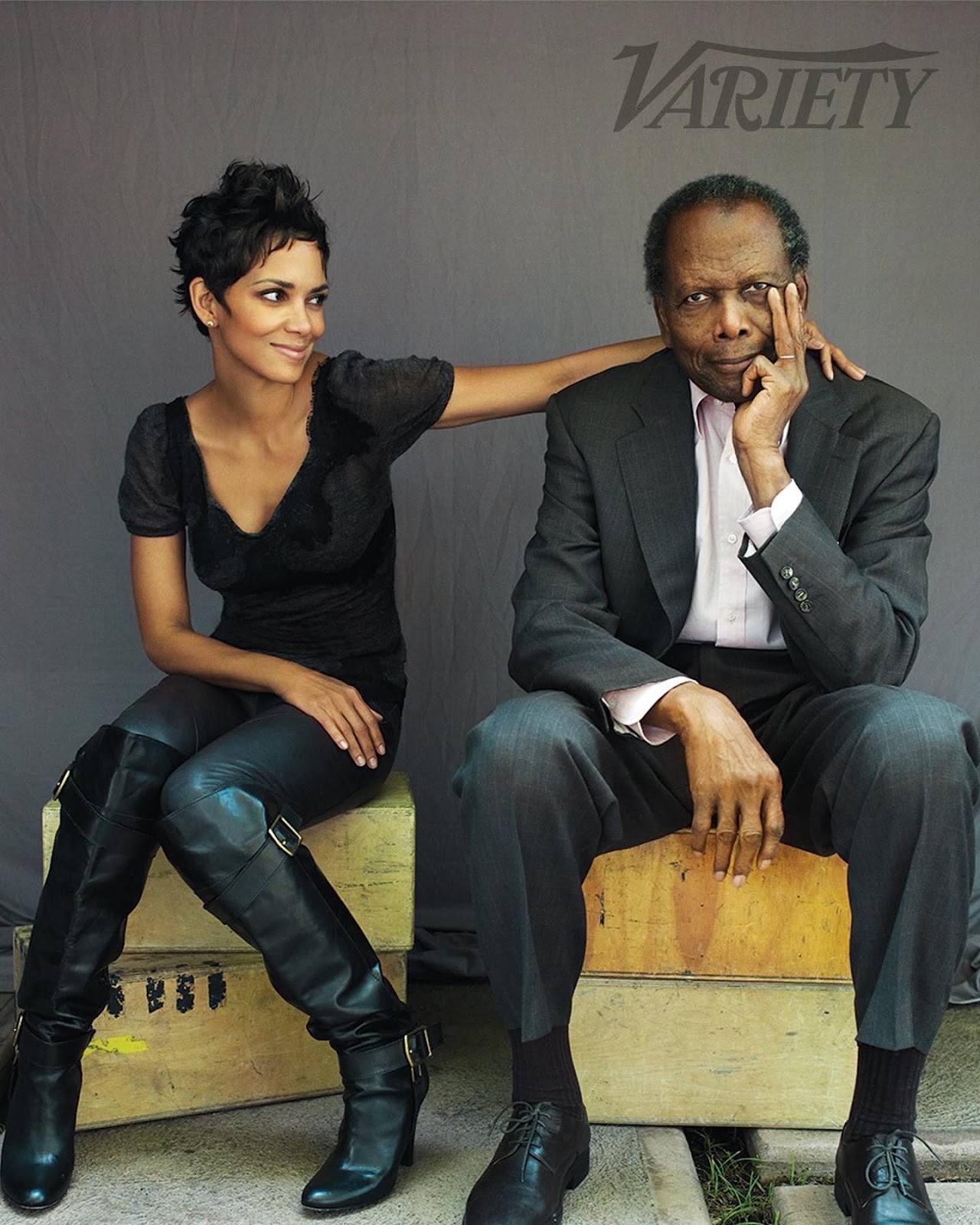
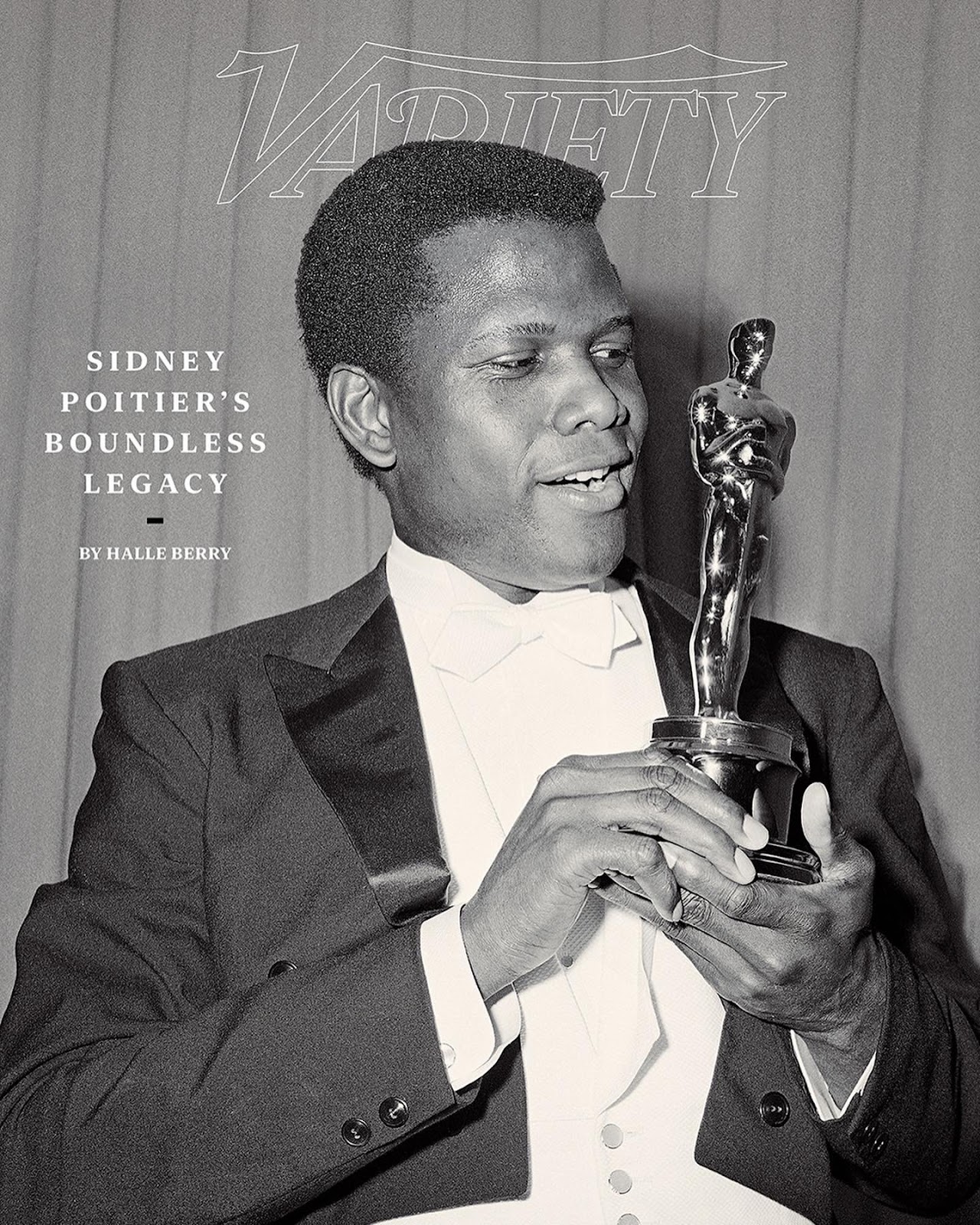
Trailblazer to Trailblazer! Sidney Poitier, the first black man to win an Oscar for Best Actor, passed away on January 6, 2022, at the age of 94 and Halle Berry, the first black woman to win an Oscar for Best Actress, thanked him for "decades of friendship".

In a new feature for Variety, the award-winning actress expands on her initial statement and pens a touching tribute to her late friend. Read her moving words below:
Halle Berry Pens Tribute to Sidney Poitier: ‘An Angel Watching Over All Of Us’

I grew up idolizing Sidney Poitier.

I was around 9 when he flickered into my world on a television replay of “Guess Who’s Coming to Dinner.” I was a latchkey kid in Cleveland, daughter of a white, single mother and a Black father — whose union their parents had frowned upon. In the film, Sidney and his co-star, Katharine Houghton, play an interracial couple whose parents also struggle with their children’s relationship. There I sat in front of my mom’s old console, mesmerized, as I watched my family’s dynamic play out. For the first time in my childhood, I felt seen. Understood. Validated. The world already knew Sidney, who died last week at 94, as a formidable performer. But I first experienced him as a mirror.

I watched that film over and over again, through my middle-school years and beyond. By then, my mother had moved our family from a Black enclave in Cleveland’s inner city to the suburbs, where I became one of a few Black students in a sea of Caucasian faces. I was a child who, like my parents’ interracial relationship, never quite fit in. In those years, it was rare to see Blacks in leading roles, much less have our narratives celebrated or even acknowledged. Cicely Tyson and Diana Ross were on the scene, as was the fresh memory of Dorothy Dandridge, the Black actress I idolized as much as I did Sidney. Back then, their mere presence was itself a form of protest. A challenge to the notion of whiteness as humanity’s high-water mark. Still, those images were scarce. As a child born to a white woman and a Black man, I felt alone and misunderstood. “Guess Who’s Coming to Dinner,” as great art does, was an affirmation that I mattered. Also, it gave others a window into my reality, of what it felt like to navigate the world with both Black and white parents.

Sidney’s impact on me did not end there. Over the years, I looked to him as a sterling example, as a template of manhood and all that is honorable. I was just 4 when my parents separated, when my father’s alcoholism upended our family. As imperfect as my dad was, as deep of a wedge as his fury drove between us, I loved him, missed him, longed to have him close. In my mind’s eye, and in my father’s absence, Sidney epitomized what a man should be: unflappable and courageous, eloquent and proud, charming and handsome. He even physically resembled my father. I wasn’t yet born in 1964 when Sidney became the first Black man to win an Academy Award for best actor for his role in “Lilies of the Field.” But years later, when I witnessed the moment in a Black History class, I could not look away. Sidney’s grace and poise, the intention with which he spoke, the dignified way he carried himself — all of it resonated with me. Though I hadn’t met him, and did not dream that I ever would, I felt strongly connected to him.

That connection has followed me through my career. Nearly 40 years later when I began work on “Bruised,” my foray into directing, I was inspired by Sidney. He was brave. He took chances. He was a fighter. He demanded respect, just as his character once had when he confronted a white man in the 1967 film “In the Heat of the Night.” In the film, Sidney plays Philadelphia police detective Virgil Tibbs. When a plantation owner named Mr. Endicott (Larry Gates) slaps Virgil, Sidney’s character immediately slaps him back, and he does not wince when he does so. That scene became a defining moment for Black people everywhere, and it was an exchange Sidney insisted be included in the movie.

“There were some flaws in the script that had to be corrected,” Sidney said in an interview. “I felt certain things were not appropriate in terms of the reality of the times.” He told the film’s producers: “In my life, whether I’m a detective or not, and I don’t care where I am, if such a thing happened to me, the likelihood is I would respond. And my response would certainly not be to absorb it.” That was not designed to be a big social comment. It was an actor’s note based on a man’s humanity. Like the character he played, Sidney simply would not allow himself to be diminished. His courage unleashed in me a sense that I, too, could stand in my power. I, too, could refuse to be diminished and perform the kinds of roles that I desired. On my own terms.

Sidney’s journey to Hollywood was more unlikely than my own. He grew up on Cat Island in the Bahamas as the youngest child of impoverished tomato farmers. At the age of 15, and with just three dollars in his pocket, he moved to New York. With little formal education, he eked out an existence as a dishwasher and ditch digger while teaching himself to read. He eventually spotted an ad from the American Negro Theatre in Harlem and auditioned to become part of the company.

Because of his thick Caribbean accent, however, he was turned away. That rejection did not dampen his resolve, but instead strengthened it. Sidney purchased a radio and began mimicking the pronunciations of American newscasters. When he returned to the theater’s acting school, volunteering to work as a janitor, he finally secured his spot. His break came in 1946 when Harry Belafonte, another student at the school, missed a rehearsal attended by a Broadway producer. In stepped the determined Sidney, who was eventually cast as Probulos in “Lysistrata.” That role opened the door for his illustrious body of work to follow, including “The Defiant Ones,” ”A Raisin in the Sun” and “To Sir, With Love.”

Sidney also directed nine films. In fact, though he is widely applauded for his scores of searing portrayals, his work behind the scenes was as important as his on-screen work. It served as a blueprint for future filmmakers, for Black people who yearned to demonstrate their value on both sides of the camera. At a time when it was completely unheard of for a Black person to direct, Sidney defied expectations and forged ahead, directing “Stir Crazy,” the third-highest-grossing film of 1980, behind “The Empire Strikes Back” and “9 to 5.” It was the first film with a Black director to earn $100 million at the domestic box office. In so doing, Sidney created an opening for me and other filmmakers to follow. He did more than blaze a trail, he cleared a forest.

Sidney selected his roles carefully. In a nation that routinely demonized Blacks both on-screen and off, and in a media landscape that showed little respect for our humanity, he knew he did not have the luxury of playing characters that would further denigrate us. “It’s a choice, a clear choice,” he once said in an interview. “If the fabric of the society were different, I would scream to high heaven to play villains and to deal with different images of Negro life that would be more dimensional. But I’ll be damned if I do that at this stage of the game.” For that stance, and as the civil rights movement took a more defiant turn in the late 1960s, he received criticism even from some in his own community. Yet I respected his choices. He intended to present our people with the same dignity he strode through the world with. He relied only on his own moral compass, on his own sense of how to best use his gift. “I did not go into the film business to be symbolized as someone else’s vision of me,” he once said. His artistic choices were his way of raising his voice.

Years after I admired Sidney from afar, I met my idol in person. I was at work on the 1999 HBO film “Introducing Dorothy Dandridge,” the story of another trailblazer who made history when she was nominated for an Oscar. I’d arranged to interview him, to glean what I could about Sidney’s memories of Dorothy, as well as to hear what it was like to be Black in Hollywood during a time when there was little place for us in the industry. I greeted Sidney, eyes dancing, cheeks lifted — and then I froze. It is the only time in my life when I have been rendered speechless! I was so overwhelmed by his powerful presence, his regal aura, I could not get my words out. For several minutes, I just sat there and stared at him.

Being the gentleman that he was, Sidney took the lead in our exchange until I regained my composure and managed to speak. With his warm manner, with the same grace he displayed on-screen across the decades, he put me at ease. He shared how he and Dorothy felt an instant kinship. He connected to her sense of honesty and vulnerability, said he viewed her as a fawn in need of protection. He also felt she’d been robbed of an Oscar for her lead role in “Carmen Jones.” “As Black people,” he told me, “we must learn to swallow it bitter and spit it sweet” — a phrase I’ve clenched tightly throughout my career. Sidney understood how often artists of color are overlooked, how our talent is so frequently discounted. He did not let that reality define him. At the end of our two-hour meeting, I left with my head held high and my chest poked out because he paid me the highest compliment. “I can’t imagine anyone other than you bringing my dear friend Dorothy to the screen,” he said. “You embody the essence of who she was.” It is a conversation I will forever treasure.

A few years later, my tongue got tied yet again when I saw Sidney at a gala. He was seated at my table alongside his wife Joanna. I glanced over at him and … Could. Not. Move. In an attempt to calm myself and restore my voice, I began talking with Joanna. Once I found my confidence, I told Sidney how much he meant to me. “You look like you could be one of mine,” he quipped, noting what he saw as my resemblance to his daughters. I realized then that, whenever I’d see Sidney, my knees would weaken and my words would vanish. That is just how important he was in my world. He wasn’t just America’s first Black film hero. He was nobility and class personified.

In 2002, nearly 40 years after Sidney accepted his Academy Award, I took my place in the Kodak Theatre for the Oscar ceremony. On that evening, Sidney, who was seated in the balcony with his family, was to be presented with an honorary Oscar. I thought that would be the highlight of the event. I’d been nominated for my role in “Monster’s Ball,” but I truly did not believe I would win. My family seemed to feel the same. “No matter what happens,” they told me, “you’ve already won. Nobody can take this moment away from you.” Deep down they felt as I did, that some other name would be called. In fact, I’d already made peace with that. My fellow nominees were all so talented that if any of them had earned the gold, I would not have felt robbed.

I was so persuaded one of them would win, I didn’t even prepare a speech. When Russell Crowe, red envelope in hand, uttered the phrase, “And the Oscar goes to … Halle Berry, ‘Monster’s Ball,’” I sat frozen, my body stuck in that seat, my spirit floating somewhere above me. “Get up, get up, you gotta get up!” my manager urged me. I don’t even remember walking up to the stage, nor do I recall the rapturous applause. My first memory is seeing Denzel Washington stand up. My next memory is hearing Russell say in my ear, “Breathe, mate. Breathe!” In the absence of a written speech, my subconscious came pouring forth, a mix of gratitude and astonishment, a recognition of those who’d paved my way — just as Sidney had.

As I concluded my rambling speech I looked up and saw dear Sidney, high in the balcony seemingly with a halo surrounding him, looking over me as a proud father would. Our paths had crossed all those years earlier when I, wide-eyed and frizzy-headed, watched him in awe from my living-room sofa. Decades later in that arena, our lives became inextricably connected — he, the first Black man to garner a leading-man Oscar, and I, the first Black woman to accomplish the same in my category. I was as tongue-tied in that moment as I was when I’d initially met him, as moved as I still am when I watch his films. History will remember Sidney as a giant of the screen, a legendary actor and director, a performer whose enormous talents were eclipsed only by his kindness. I will recall him as my first mirror, and the true measure of a man — and I will forever see him as the angel in the balcony watching over all of us.

Halle Berry is an Oscar-winning actor, director and activist.

Monday, October 18, 2021

Halle Berry Covers Women In Hollywood Issue Of 'Elle'

Trailblazer Halle Berry, who is still the only black Best Actress winner, is one of the nine stars featured on the November issue of Elle magazine, celebrating the honorees for this year's Women In Hollywood event, which will take place tomorrow (10/19).
When Halle Berry first read the script of her most recent film, Bruised—which she directs and stars in—she knew it wasn’t going to work for her. The Netflix movie, about a troubled mixed martial arts fighter who tries to get back into the sport when she regains custody of her son, was clearly written for an actress who could play an Irish Catholic woman in her early twenties. Berry was drawn to the intensely physical and emotional story, and identified with the motherhood subplot, but she recognized that the lead role would have to be reworked if a Black woman in her fifties was going to play her—even if it was a Black woman who has looked ageless for her entire career.

Another actress was considering the project, and Berry’s agent told her to wait to see if the film came to her instead. “I couldn’t stop thinking about it, and I became obsessed,” Berry says. When the other actress eventually passed, Berry was ready. “I was then able to make my pitch for how I could reimagine it for someone like me,” Berry says. She helped rework the screenplay, and after meeting with several potential directors, she realized that she might be the best person for that job, too. The resulting film is harrowing and deeply affecting, with Berry again doing what she does best: showing us a complicated Black woman in a way we haven’t seen before onscreen.

Bruised shows Berry doing what she does best: portraying a complicated Black woman in a new way. But this time around, she’s also behind the camera.

[Click Here to Read More]

Sunday, September 19, 2021

Halle Berry Talks 'Bruised' With 'The New York Times'

Halle Berry, in some form or another, has been fighting her whole life. Be it for coveted movie roles, on behalf of victims of domestic violence like herself, or against a perception that her physical beauty has insulated her from struggle, she has always seen herself as an underdog. And now, in her first film as a director, she has cast herself as one, too.

In “Bruised” (premiering theatrically Nov. 17 before moving to Netflix a week later), Berry stars as Jackie Justice, a humiliated mixed martial arts fighter desperate to stage a comeback. It is her most physically demanding role: Now 55, she had to train four to six hours a day to learn boxing, Muay Thai, judo and jujitsu, as well as brush up on the capoeira skills she used in “Catwoman.

[Click Here to Read More]

Thursday, September 16, 2021

'Entertainment Weekly': Halle Berry Fights Her Way Into The Director's Chair With 'Bruised'


Halle Berry is no stranger to going all out for her roles, but her latest role in 'Bruised' sees her visiting new territory as the film serves as her directorial debut.

In the September issue of Entertainment Weekly, the cover star opens up about fighting ageism in Hollywood, not being in love with her resume, continuing to fight after her historic win and pushing through injury. Read quotes for her beautiful shoot below:


On Ageism: "It used to be when you were 40 your career was done, and I mean really done," she says. "Or you had to wait until you were old enough to play a grandma, and then you could have another bite at the apple, right? I mean, I couldn't think that I'd be playing an MMA fighter at 54 years old. Yet I did, so it's got to be changing. I'm proof of that."


On Past Roles: "It's like, okay, that's a film I can't say I'm totally in love with, but this isn't a hobby. It's how I take care of my children. But I try to keep that sense of wonder and stay curious. Because being a Black woman, I haven't always had parts that I absolutely love.'"

On Her Fight Post-Oscar: "It was surprising," she acknowledges of her prospects post-Oscar, when the expected deluge of offers for prestige directors and projects never came. "Because I thought they were going to just back up the truck and drop them off at my house, right? When you have a historic win like that, you think, 'Oh, this is going to fundamentally change.' It did fundamentally change me, but it didn't change my place in the business overnight. I still had to go back to work. I still had to try to fight to make a way out of no way."

On Pushing Through Injury: With Wick, she recalls, "I told the director about it, they told the insurance. We had to shut down for months and it was a big ordeal. On this, because it was an independent movie, we didn't have a big budget. The director in me said, 'I didn't come this far and work this hard to go home.'"

Thursday, September 10, 2020

Halle Berry Takes Hold Of Director's Chair With 'Variety'


Halle Berry plays cover girl for the new issue of Variety, where she discusses some of her career failures ('Catwoman', Jinx spinoff), why being the only black Lead Actress Oscar winner breaks her heart and how she found her way to the director's chair for 'Bruised'.

When Berry got hurt on “Bruised,” after taking a knee to the chest from co-star Valentina Shevchenko, she wasn’t surprised. But this time, the stakes felt momentous. “Bruised,” which premieres at the Toronto Film Festival this week, is also her directorial debut. The magnitude of the opportunity wasn’t lost on her, as a woman and a Black artist in an industry where the odds of directing a movie are slim if you’re not a white man. To make sure she was ready each day, she’d wake up at 5 a.m., and she couldn’t let the pain from broken ribs slow her down.

“I didn’t want to stop because I had prepared for so long,” Berry says. “We had rehearsed; we were ready. So my mind, my director’s mind, was just — keep going. And I compartmentalized that, and I just kept going: ‘I’m not going to stop. I’ve come too far. I’m going to act as if this isn’t hurting. I’m going to will myself through it.’ And so we did.”

In many ways, that’s been Halle Berry’s story. She’s refused to stop, despite the hurt — rejections from roles that could have been hers, pursuing scripts that were written for white actors (including “Bruised”) — even after she’d torn down barriers. For her Variety cover story, Berry didn’t flash a movie star smile during a socially distanced photo shoot in Los Angeles. “I do feel at risk,” she says, referring to her diabetes. “I’m very strict about quarantining and who is in my bubble. We have a whole section of the house: When you go out in the world and buy something, it has to sit in this purgatory.”

Berry, who has frequently been in the tabloids following her public breakups (she’s currently representing herself in her divorce from actor Olivier Martinez), didn’t volunteer any details about her personal life or talk about her two kids during a 90-minute interview. She wanted to discuss her career, including the heartbreak that her historic 2002 Oscar win didn’t lead to change, fights with Bryan Singer during the “X-Men” franchise and her long journey to the director’s chair.

“I definitely feel like there’s a turning point,” Berry says about the forward movement for women directors. “I’m more encouraged that as women, we are feeling confident enough to tell our stories. And there is a place for us to tell our stories. For so long, our experiences have been told narratively through the guise of men.”


Berry discovered acting in the years post-college, after contemplating a career as an investigative journalist. Her first part was on “Living Dolls,” in which she played Emily, the lone Black character on the 1989 ABC sitcom about a sorority of teenage models. “I had a job, but I didn’t have a real part or purpose on that show,” Berry says. “I was very much the token Black person that didn’t have a storyline that was very compelling or meant much. I was the character that started every scene with ‘Hey, guys!’ and ended everything with ‘Come on, let’s go.’ Today, that wouldn’t happen, when you look at the landscape of television about the Black experience.”

Movies proved more welcoming. Berry made an indelible mark on the big screen in 1991’s “Jungle Fever,” in which she pitched herself to director Spike Lee for the role of a “crack ho” instead of the “pretty wife.” Throughout the ’90s, she worked steadily, portraying everything from the villain in the live-action “The Flintstones” to an activist in Warren Beatty’s political satire “Bulworth.” She landed an Emmy for the 1999 HBO film “Introducing Dorothy Dandridge,” written by a then-unknown Shonda Rhimes, and earned international box office stardom as Storm in 2000’s “X-Men” and in three sequels.

But “Monster’s Ball” was an even bigger peak in her career. In 2002, for her performance as a waitress consumed by grief in the indie drama, Berry became the first (and still only) Black woman to win the best actress Oscar. That same year, she starred as the seductive spy Jinx in “Die Another Day,” the 20th James Bond film, which grossed more than $400 million globally.

And then — nothing. Big directors such as Steven Spielberg and Martin Scorsese never came calling. Hollywood seemed to revel in her failure with 2004’s “Catwoman,” a cheesy flop about the comic book villain, which swept the Razzie Awards. More recently, Berry has popped up in popcorn action movies such as 2013’s “The Call” and 2017’s “Kidnap.” Through it all, she says, she’s never stopped fighting for roles.


“I think it’s largely because there was no place for someone like me,” says Berry, who has been encouraged by the recent discourse about inclusivity in the industry. “I thought, ‘Oh, all these great scripts are going to come my way; these great directors are going to be banging on my door.’ It didn’t happen. It actually got a little harder. They call it the Oscar curse. You’re expected to turn in award-worthy performances.”

In her Academy Awards speech, Berry — through tears — said that she’d opened a door for “every nameless, faceless woman of color” watching at home. Two decades later, she can’t fathom the reality that not a single leading Black woman has followed. “I thought Cynthia [Erivo, the star of ‘Harriet’] was going to do it last year,” Berry says. “I thought Ruth [Negga, nominated for 2016’s ‘Loving’] had a really good shot at it too. I thought there were women that rightfully, arguably, could have, should have. I hoped they would have, but why it hasn’t gone that way, I don’t have the answer.”

Berry is still conflicted about what her Oscar win represents. “It’s one of my biggest heartbreaks,” she says. “The morning after, I thought, ‘Wow, I was chosen to open a door.’ And then, to have no one … I question, ‘Was that an important moment, or was it just an important moment for me?’ I wanted to believe it was so much bigger than me. It felt so much bigger than me, mainly because I knew others should have been there before me and they weren’t.”

In retrospect, Berry says it was naive to think a statue would change anything. “Just because I won an award doesn’t mean that, magically, the next day, there was a place for me,” she says. “I was just continuing to forge a way out of no way.” She likens it to how Dorothy Dandridge must have felt at the 1955 Academy Awards, as the first Black actor nominated for a lead role, who then went back to being an outsider in Hollywood.


After the success of “Die Another Day,” “Bond” producers Barbara Broccoli and Michael G. Wilson lobbied for Jinx to get her own spinoff, an idea that thrilled Berry. But MGM balked at the $80 million price tag. “It was very disappointing,” Berry says. “It was ahead of its time. Nobody was ready to sink that kind of money into a Black female action star. They just weren’t sure of its value. That’s where we were then.”

Instead, she decided to portray Catwoman, thinking that it was a risk that could pay off — and change the kinds of roles offered to Black actors. “People said to me, ‘You can’t do that. You’ve just won the Oscar,’” Berry says. “Because I didn’t do Jinx, I thought, ‘This is a great chance for a woman of color to be a superhero. Why wouldn’t I try this?’”

But she quickly noticed warning signs. “The story didn’t feel quite right,” she says about a dubious plot that involved a villain (played by Sharon Stone) with a cosmetics empire. “I remember having that argument: ‘Why can’t Catwoman save the world like Batman and Superman do? Why is she just saving women from a face cream that cracks their face off?’ But I was just the actor for hire. I wasn’t the director. I had very little say over that.”

When Berry first read the script for “Bruised,” she felt a strong connection to the character, an MMA fighter named Jackie Justice who returns to the cage when everyone has counted her out. Berry had been training for three years in mixed martial arts. To perform some of her stunts on “John Wick,” she’d immersed herself in jujitsu, judo, taekwondo and kickboxing — and she saw herself in the character of Jackie. But she had to be patient. Another director, Nick Cassavetes, was attached to make the movie with Blake Lively as the star.

“I’m tortured, because now I can’t let it go,” Berry says of the waiting period. “I’ve been thinking of how I can reimagine it for someone like me, a Black woman in middle age — not starting life — who’s looking for a last chance, not another chance. I’m stuck on it.”

Six months later, when the script became available, Berry pitched herself as the lead to the producers — including Basil Iwanyk of Thunder Road Films, who made “John Wick” and “Sicario.” “Why not a Black woman?” Berry remembers thinking. “It’s an old genre; there’s so many great fight films that have been made. I made the point why it would be worth retelling an age-old story with this new twist.”


She convinced the movie’s creative team, but they needed a director. Berry met with seven candidates. But she came away from all of those conversations feeling dissatisfied — nobody saw her vision of the film.

Finally, her producing partner, Elaine Goldsmith-Thomas (“Hustlers”) came up with an idea: Berry should direct the movie herself. “I remember listening to her feedback from one of her meetings,” Goldsmith-Thomas says. “I just said, ‘This is nuts. You’re waiting for someone to tell you the things you know. You understand the evolution of redemption. Why the f— aren’t you standing in your own truth?’”

Directing was something that Berry had always thought about, having spent 30 years on movie sets, quietly observing — “watching and learning and absorbing” — how everyone from Lee to Beatty framed a scene. But when she’d had conversations about directing before, they’d been in the abstract. Now she had to sell herself as the first-time director of a real script. “I thought, ‘They’re going to think I’m high,’” Berry says. “They’re going to think, ‘Halle has lost her mind.’”

But instead, they hired her. For Berry, directing felt like a career rebirth. She threw herself into every aspect of production, from script revisions to cinematography. “It’s not just being a dancing bear,” Berry says. “I can project what I want to say.” She found the director’s chair far more empowering than being an actor. “As an actor, I always show up and do my part, and I can only do what I can do,” she says. “Being the director, I have a part in the totality of every department. I get to have a voice. That was different, and I really loved that.”

When she learned that “Bruised” would be playing in Toronto, Berry screamed in celebration — she’d submitted a “work-in-progress” cut of the film, not knowing COVID-19 would restrict international travel. “I’m hearing they’re going to send out screeners, but I’m thinking, ‘That’s piracy waiting to happen,’” Berry says before conceding that the details will be ironed out. In a follow-up email, she clarifies that “Bruised,” which is seeking distribution, won’t be doing virtual screenings. It will premiere on Sept. 12 in Toronto before a live audience.


“I’m hopeful that whatever partner comes along, they’ll support my vision and we’ll work together to bring a fully finished film to the mass public at the right time,” Berry writes. “That said, I’m extremely excited, and nervous and elated (and feeling all of the feels), for the first Toronto audience to see it.”

On YouTube, Berry’s Oscar acceptance speech has been viewed more than 5 million times. It’s still as inspiring today as it was in 2002 to watch presenter Russell Crowe open the envelope and read her name. Berry looks shocked — for the record, she says, that wasn’t a performance. Berry didn’t expect to win that night, and she hadn’t even written a speech. “The only thing I remember,” she says, “is somehow I was up on the stage, and I remember Russell whispering in my ear, ‘Breathe, mate. Breathe.’ Then I remember I turned around and saw all the faces and started talking.”

One of Berry’s professional hurdles has been to convince directors to look past her beauty. “That is a blessing and a curse,” she says. “People always wanting to see my physical self first, and then some will argue, ‘That’s what got you in the door.’ But even if that got me in the door, I’ve had to fight that image of being stereotyped, fight to be seen as an artist.”

On “Monster’s Ball,” even after she was cast, members of her team cautioned her about playing a character who has sex with a racist corrections officer (Billy Bob Thornton). They thought it could damage her image.

“It was a little movie,” Berry says. “And it had this love scene that, I guess, was explicit in the minds of some people. And I was getting paid nothing. They thought if you’re going to do something like that, get a s—load of money. But that’s not why I’m doing it. I didn’t feel it was exploitative. It was necessary for the character.”


A few years ago, Berry retired one of her most well-known performances, as Storm, in 2014’s “X-Men: Days of Future Past.” Since then, the film’s director, Singer, has been accused of sexual assault by at least four men who say they were underage at the time (which he denies); he also was fired mid-shoot from 2018’s “Bohemian Rhapsody” for allegedly not showing up to work (which he also denies).

When asked about her experiences with Singer, Berry answers the question with ellipses. “Bryan’s not the easiest dude to work with,” she says. “I mean, everybody’s heard the stories — I don’t have to repeat them — and heard of his challenges, and what he struggles with.

“I would sometimes be very angry with him,” she continues. “I got into a few fights with him, said a few cuss words out of sheer frustration. When I work, I’m serious about that. And when that gets compromised, I get a little nutty. But at the same time, I have a lot of compassion for people who are struggling with whatever they’re struggling with, and Bryan struggles.” (Singer, through his publicist, declined to comment.)

“Sometimes, because of whatever he’s struggling with, he just didn’t always feel present,” Berry says. “He didn’t feel there. And we’re outside in our little ‘X-Men’ stage freezing our ass off in Banff, Canada, with subzero weather and he’s not focusing. And we’re freezing. You might get a little mad.”

Berry has been inspired by the #MeToo movement. “Clearly, things need to change,” she says. “And what we as women were acquiescing to, and were allowing needs to change. And it needed to get blown up. And people needed to be outed.”

It’s too early to say when she’ll direct again, but she’d like to. As she was editing “Bruised,” she showed a version to Spike Lee, the first director who ever hired her to be in a film. “Holy s—,” he told her. “You made a movie.”

Thursday, April 16, 2020

Halle Berry Among Black Actresses Featured In 'T' Magazine


Extraordinary African-American actresses, including Halle Berry, Angela Bassett, Taraji P. Henson and more, remember their first roles and discuss the solidarity they feel with one another in the latest issue of 'T: The New York Times Style Magazine'.


Tuesday, September 13, 2016

Halle Berry Covers 'W' Magazine As A Member Of 'The New Royals'


Meet the New Royals!!! Halle Berry is featured among a stellar group of stars dubbed as "The New Royals" by the October issue of W magazine, which marks the magazine's first-ever his-and-hers fashion issue and features 11 covers.

Joining the Academy Award winner are Kanye West, Kit Harington, Priyanka Chopra, Irina Shayk, Chris Evans, Elle Fanning, Jodie Foster, Julia Louis-Dreyfus, Ethan Hawke and Rami Malek, who are each treated to their own cover for the coveted issue.

W Magazine: Halle Berry was one of the original female stars during the first wave of comic-book movies, when she cast thunderbolts as Storm in the first X-Men movie in 2000, a year before she won an Oscar for Monster's Ball.

Wednesday, January 29, 2014

Halle Berry Shows Off Lightning Power On 'Empire' Cover

Halle Berry : Empire  - 02/14 photo Halle-Berry-est-Tornade_portrait_w858.jpg

Halle Berry is one of twenty-five 'X-Men' stars featured on their own cover of the March 2014 issue of Empire magazine, in support of her forthcoming movie, 'X-Men: Days of Future Past', which will hit theaters on May 23rd. Watch the official theatrical trailer beneath:


Monday, December 20, 2010

HALLE BERRY COVERS 'THE HOLLYWOOD REPORTER'

The Hollywood Reporter
80th Anniversary of 'The Hollywood Reporter': The Legend's Issue
First African-American Oscar winners: Best Actress (Berry) and Best Actor (Sidney Poitier)